Last week two friends, Erica and Gina, and I went to Istanbul for Semana Blanca. It was incredible; I loved the city and highly recommend it to everyone. We saw so much and did so many things that I’m going to split the trip into a few blogs, also I took close to 600 pictures (don’t worry I’m not posting all of them) so I need to break them into groups! First up, sites and cultural attractions…
Istanbul is the only city in the world that spans two continents, which is pretty cool. We went to the Asian side and I have now been to five continents, I just need South America to complete my worldwide travels! I realize there are seven continents but I don’t see myself going to Antarctica any time soon so I’m going to pretend it doesn’t exist for the time being. Istanbul, formerly Constantinople is a fascinating mix of eastern and western cultures. When you walk around it feels like any other European city, busy, commercial, modern, and yet because it’s an Islamic country the call to prayer is broadcasted five times daily throughout the city. You almost forget you’re in an Islamic country until you hear the call to prayer. I thought that more women would be wearing hijabs (the traditional Islamic outfit for women that covers everything except their eyes), but because it is such a modern city we mainly saw older women wearing the outfits, which you can see in any city in the world.
The main attractions in Istanbul are the two large mosques, the Hagia Sophia and the Sultanahmet Mosque (better known as the Blue Mosque), the Topkapi Palace, the Tomb of the Sultan and the Galata Tower. We saw every single one – what fabulous tourists we are. Granted we didn’t climb the tower because we felt the 11 Turkish Lira (6.5 euros) was a little pricey, but we saw it and took pictures, so close enough.
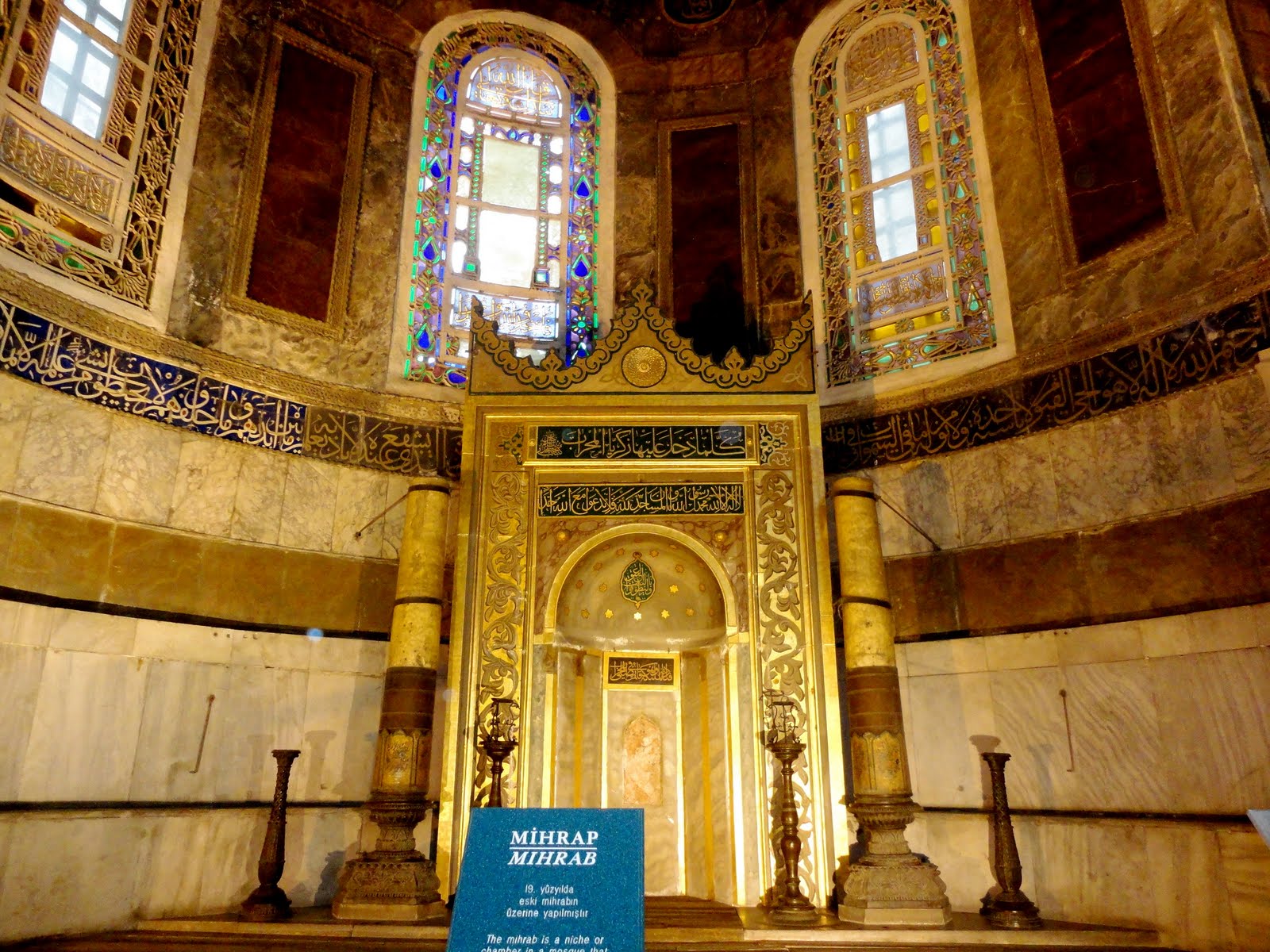
The Hagia Sophia was dedicated in 360 and served as the principle church of Constantinople until 1453 when it was converted to a mosque after the Ottoman Turks conquered Constantinople. At one time it was the highest building in the world (180 feet). Although it is now a museum, the Hagia Sophia remained a public moque until 1931. When Sultan Mehmed II and the Turks conquered Constantinople, he ordered the cathedral to be renovated to incorporate traditional elements of a mosque. Many of the original mosaics and paintings were removed, and traditional Islamic elements such as a mihrab, minbar and four minarets were added. A mihrab is a semicircular altar in a mosque that points in the direction of Mecca, a city in Saudi Arabia regarded as the holiest site in Islam. During prayer, all members face Mecca. A minbar is the pulpit where the imam (leader of prayer) stands during services. Minarets are tall spires that are used for the call to prayer.
The most interesting aspect of the Hagia Sophia is the contrast between the exterior and interior of the building. From the outside, the building’s size is the largest attraction. It is red and beige and does not stand out as a beautiful building. However, the minute you walk inside the interior beauty more than makes up for the bland exterior. It’s much larger than you think it’s going to be and it’s absolutely stunning. The intricate decorations, tiles and mosaics are beautiful and it’s hard to imagine the care and dedication it took to create it all.

Hagia Sophia

Dome in the Hagia Sophia
Mihrab in the Hagia Sophia

Hagia Sophia

Hagia Sophia

Signature of the Sultan in Hagia Sophia

Hagia Sophia

Hagia Sophia

Hagia Sophia

Mosaic in the Hagia Sophia

Mosaic in the Hagia Sophia (flashbacks to Art History in high school...)

The Empress and her Sarcophagus

Fountain in the Hagia Sophia

One of the Hagia Sophia's minarets
The Sultanahmet Mosque, more popularly known as the Blue Mosque (because of the blue tiles on the interior) was built between 1609 and 1616 during the rule of Ahmed I. The mosque is also known as the Sultan Ahmed Mosque, after it’s creator. The Blue Mosque is still used today, so you can only visit during certain times of the day when it’s not in use for religious reasons. Also, because it is still open, you have to remove your shoes and cover your head inside the mosque. My boots were too big for the plastic bag they gave us and ripped it open…big foot strikes again.
Considered the last traditional mosque of the classical period, the Blue Mosque is a mixture of architecture, incorporating some elements of Byzantine architecture similar to the Hagia Sophia with traditional Islamic architecture. Like the Hagia Sophia, the Blue Mosque is also quite stunning. Even though you can only walk in certain areas because it’s still a public mosque today, you’re able to see enough to appreciate the decorations. What I found most interesting about both the Blue Mosque and the Hagia Sophia were all the tiles that decorate the walls. Every one is hand painted with intricate designs, and although they don’t always match, the combinations are beautiful.
Sultan Ahmed Mosque (Blue Mosque)

Blue Mosque

Blue Mosque

Blue Mosque
Blue Mosque

Gina and Erica in the Blue Mosque

Restricted section of the Blue Mosque, still used for prayer today

Women's Section of the Blue Mosque

Minbar in the Blue Mosque
The Topkapi Palace was begun in the mid-15th century and served as the Sultan’s primary residence for 400 years. In contrast to other palaces like Versailles, the Topkapi Palace has been converted into a museum, so when you visit you don’t walk through the palace as it was during the Sultan’s rule. While this was a drawback, the relics housed in the Topkapi Palace are worth the trip. Among other things the palace houses the Prophet Muhammed’s sword, cloak and beard. Yes, his real beard. Originally I thought it was a religious artifact I didn’t understand but once you see the teeny tiny hairs you get that they’re talking about an actual beard. Unfortunately you can’t take pictures of most of the relics, so you just have to take my word for it how interesting they were. I think my favorite rooms were those that had the spoils of war, objects that the Ottoman Turks stole during wartime, especially The Spoonmaker’s Diamond. A pear shaped diamond, it’s 86 carats and approximately the size of my hand. It was found in a trash heap and sold for three spoons, hence it’s name. Some poor guy probably thought it was fake and believed he was making a killing getting three spoons for a hunk of rock…wrong.
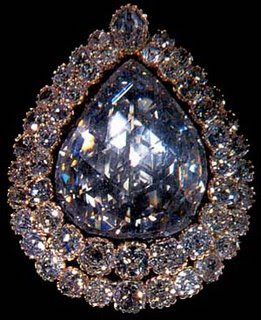
86 carat Spoonmaker's Diamond
Aside from the spoils of war, the Harem was the most interesting section of the palace. A smaller area, the Sultan’s concubines lived there and from what we understand the Harem was where the Sultan could do whatever he wanted. I’m equating it to the ancient version of Charlie Sheen’s house. The Sultan and his many concubines lived in the Harem; the various rooms include baths, private chambers, fountains and courtyards. Interestingly, the Queen Mother also lived there, which is just weird. Similar to the mosques, the palace and harem are decorated with small hand painted tiles all over the walls and ceilings.
Outside the Topkapi Palace

Topkapi tiles

View of Istanbul from the palace

Dome in the Topkapi Palace

Courtyard in the Topkapi Palace

Being idiots at the Topkapi Palace

Topkapi Palace

Hiding in the Harem

Courtyard in the Topkapi Harem

Concubines

Courtyard in the Topkapi Harem

Harem

Harem

Harem

Private chamber in the Harem
The Tomb of the Sultan is one of the least advertised yet most interesting attractions in Istanbul. It’s a graveyard for Sultans! So cool. Tens of Sultans are buried there, although I’m not sure if they’re actually buried there or if each tomb is representative, but it’s still really fascinating. Many of the Sultans came to power before the age of twenty and died before reaching thirty and are all buried together.
Tomb of the Sultan

Sultan's tombstone

Graveyard for Sultans

Tomb of the Sultan
The Galata Tower is on the less touristy side of the Bosphorus River. Istanbul is separated by a river on the European side and an ocean on the Asian side…very confusing. We didn’t really know where we were some of the time and for a brief second thought or trip to Asia was just a trip to Europe...but thankfully we were mistaken. The tower was completed in 1348 and was the city’s highest building at its completion, 219 feet. It was used as a fortification of the old Galata city, providing very good visibility from the top. When we went it was pretty cloudy so we decided that the view wouldn’t be good enough to go up. We did visit the gift shop and see what the view could look like, which was good enough for us.

Freezing on the Galata Bridge

Galata Bridge

Galata Tower

The book from Hocus Pocus that we found in the Galata Tower gift shop